The LET Effect
Lower Failure Rates Without Extra Complications

You’ve done the work.
Months of prehab, the emotional hurdle of surgery, and the long, grinding road of rehabilitation.
The goal is clear: get back to the sport you love, stronger and more confident than before. But in the back of your mind, and in the minds of your physio and surgeon, lingers a nagging fear: what if it tears again?
For young, active athletes, this fear is grounded in a harsh reality.
The rates of re-injury or graft failure after an anterior cruciate ligament (ACL) reconstruction can be, as researchers put it, “unsatisfactorily high” (Firth et al., 2022).
But what if we could dramatically reduce that risk? What if a small addition to the standard surgery could act as a powerful insurance policy for your new ACL?
A landmark series of studies, known collectively as the “STABILITY” trial, has provided some of the most compelling answers to date on how to protect our most at-risk ACL patients.
Multiple papers have been published from this single, powerful randomized trial, giving us a complete picture of the results.
Today, we’ll dive into the main findings from the key analyses published by Firth et al. (2022), Getgood et al. (2020), Heard et al. (2023), and Rezansoff et al. (2024), to see what they did, who they studied, and most importantly, what it means for you.

The “STABILITY” Study: Who Was Involved?
To get reliable answers, you need to study the right people. The researchers didn’t look at older, less active individuals; they focused specifically on the group most likely to suffer a re-tear.
The study included over 600 young, active patients from nine different medical centers. Here’s a snapshot of the typical participant:
Age: The mean age was just 18.9 years old, with all participants being between 14 and 25.
Activity Level: These weren’t casual joggers. They were deemed “high-risk” for re-injury and were primarily involved in high-risk sports that require cutting, pivoting, or jumping - think soccer, basketball, and football.
Graft Type: This is critical. Every single patient in the study received a hamstring tendon autograft (using their own hamstring tendons) for their ACL reconstruction.
This is the exact demographic that keeps orthopaedic surgeons and physiotherapists up at night.
By focusing on this high-risk group, the study’s findings are incredibly relevant for young athletes today.
What Did the Surgeons Do?
The patients were randomly split into two groups during their surgery. This randomization is the gold standard for medical research, as it helps eliminate bias.
Group 1: The Control Group. These patients received a standard, high-quality hamstring autograft ACL reconstruction (ACLR). This is a very common and effective procedure performed worldwide.
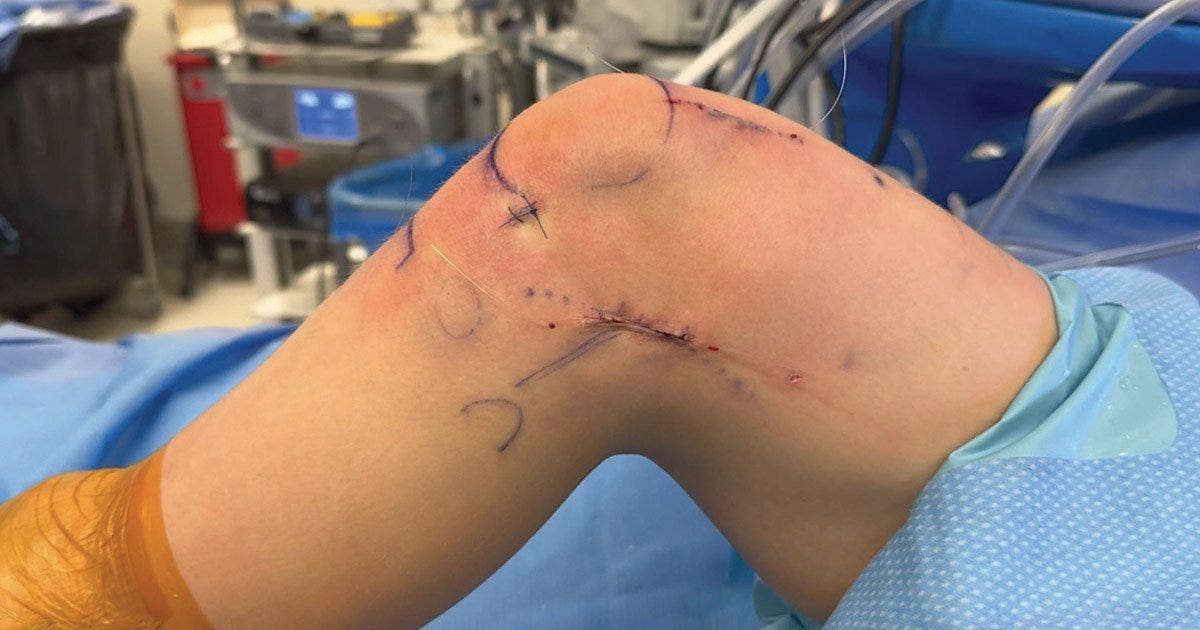
Group 2: The Intervention Group. These patients received the same ACLR PLUS a procedure called a Lateral Extra-articular Tenodesis (LET).
So, what exactly is a LET?
Think of it as a seatbelt for your new ACL graft.
It’s a small strip of tissue on the outside of the knee (the iliotibial band) that the surgeon reroutes to help control the excessive knee rotation that often leads to ACL tears (Rezansoff et al., 2024). It doesn’t replace the ACL; it supports and protects it, especially during the crucial healing and maturation phases, by reducing the forces on the new graft (Firth et al., 2022).

The researchers then followed both groups for two years to see which one had better outcomes, looking at everything from graft rupture rates to complications and return to sport.
The Key Findings…
The results, published across multiple papers, have been remarkably consistent and clear. Adding the LET procedure made a significant, positive difference.
1. Drastic Reduction in Graft Rupture
This is the headline finding. Two years after surgery, the graft rupture rate in the ACLR alone group was 11% (34 of 312 patients). In the group that received the ACLR + LET, it was only 4% (11 of 306 patients).
This finding has been echoed consistently in every analysis of this trial, with one paper reporting rates of 11.2% vs 4.1% (Rezansoff et al., 2024) and another early report showing 11% vs 4.5% (Getgood et al., 2019).
The message is undeniable: adding a LET dramatically lowers the chance of re-injury.
2. But Is It Safe?
Historically, surgeons have been hesitant to perform LETs due to concerns about complications like over-constraint and pain (Heard et al., 2023). The STABILITY trial directly addressed this, and the findings published by Heard et al. (2023) are incredibly reassuring.
When comparing the two groups, researchers found that adding the LET came with a very manageable trade-off:
Increased Hardware Irritation: The LET group had a higher rate of hardware irritation from the staple used to fix the tenodesis. 10 patients (3%) in the LET group required a minor second surgery to remove the staple (Heard et al., 2023).
More Pain, But Only at First: Patients in the LET group reported slightly more pain at their 3-month follow-up, but this difference completely disappeared by the 6-month mark (Heard et al., 2023).
Slightly Less Motion, But Only at First: Similarly, the LET group had a small, clinically insignificant reduction in range of motion at 3 months, which also resolved over time (Heard et al., 2023).
Crucially, the study found NO significant increase in any serious adverse events (Heard et al., 2023). There were no differences in the rates of infection or other major complications, and the overall re-operation rate was not significantly different between the groups (Heard et al., 2023).
3. The Return-to-Sport Question..
A stronger, safer graft is great, but the ultimate goal for any athlete is getting back on the field.
So, does a LET help with that?
A 2024 analysis of the STABILITY data by Rezansoff et al. answered this exact question.
The answer is nuanced.
The overall return-to-sport (RTS) rate was similar between the two groups. About 11% of the ACLR-only group and 14% of the ACLR+LET group did not return to sport. However, the study uncovered two critical details:
The Biggest Barrier is Mental: The most common reason athletes didn’t return to sport wasn’t pain or function - it was a lack of confidence and/or fear of re-injury (Rezansoff et al., 2024).
Stability Helps You Return to a High Level: While the LET didn’t make more people return, having a stable knee was associated with nearly twice the odds of returning to a high-level, high-risk sport (Rezansoff et al., 2024).
The conclusion?
The LET provides the rock-solid stability that can give an athlete the physical foundation needed for a high-level return. And by preventing re-tears, it ultimately keeps them playing longer.
4. Identifying the High-Risk Factors
The detailed analysis by Firth et al. (2022) also pinpointed the factors that put patients at the greatest risk of graft failure in the first place. The biggest predictors of graft rupture were:
Younger Age: For every one-year increase in age, the odds of graft rupture decreased by 17% (Firth et al., 2022).
Greater Posterior Tibial Slope: A steeper angle at the top of the shin bone was associated with a 15% higher odds of rupture for every 1-degree increase (Firth et al., 2022).
High-Grade Pre-Op Laxity: Patients with a very “loose” knee before surgery were at 3.27 times higher odds of graft rupture (Firth et al., 2022).
Earlier Return to Sport: An earlier return means more time exposed to risk, which significantly increased the odds of re-injury (Firth et al., 2022).
Actionable Takeaways.
This isn’t just data; it’s a roadmap for better outcomes.
For Patients & Parents:
If you are a young athlete (under 25) undergoing a hamstring graft ACLR, ask your surgeon about the Lateral Extra-articular Tenodesis (LET). The STABILITY trial provides powerful evidence to support its use in high-risk patients.
You can now have a very informed discussion. You can acknowledge the massive benefit of a reduced re-tear rate while also asking about the manageable trade-offs, like the potential for temporary increased pain or the small chance of needing to remove hardware.
The biggest barrier to returning to sport is often psychological (Rezansoff et al., 2024). A stable knee from a procedure like the LET can be a huge physical and mental advantage, but your rehab must also focus on rebuilding confidence and overcoming the fear of re-injury.
For Healthcare Professionals:
The STABILITY trial has shown that the LET is not only effective but that historical concerns about safety did not materialize (Heard et al., 2023). This evidence strongly supports its use in young, active patients to reduce graft failure.
This evidence shows a LET doesn’t automatically increase RTS rates, but it provides the stability that can facilitate a higher-level return (Rezansoff et al., 2024). Emphasize psychological readiness and strength symmetry as key, modifiable factors for a successful return.
Since fear of re-injury is a primary barrier to RTS, integrating sports psychology and confidence-building drills into late-stage rehab is not just helpful - it’s essential (Rezansoff et al., 2024).
The journey back from an ACL injury is challenging enough.
Doing it twice is devastating.
The STABILITY trial offers a clear, evidence-based strategy to help prevent that second heartbreak, showing that the LET is remarkably effective, reassuringly safe, and a key piece of the puzzle for a stable, long-lasting return to the game.
I really hope you enjoyed this week’s ACL research summary - tell your mates about this one!
Yours in (knee) health as always,
Mick Hughes

References
Firth, A. D., Bryant, D. M., Litchfield, R., McCormack, R. G., Heard, M., MacDonald, P. B., Spalding, T., Verdonk, P. C. M., Peterson, D., Bardana, D., Rezansoff, A., STABILITY Study Group, & Getgood, A. M. J. (2022). Predictors of graft failure in young active patients undergoing hamstring autograft anterior cruciate ligament reconstruction with or without a lateral extra-articular tenodesis. The American Journal of Sports Medicine, 50(2), 384–394. https://doi.org/10.1177/03635465211061150
Getgood, A. M., Bryant, D., Litchfield, R. B., McCormack, R. G., Heard, M., MacDonald, P. B., Spalding, T., Verdonk, P. C. M., Peterson, D., Bardana, D., Rezansoff, A. J., & Stability Study Group. (2019). Lateral extra-articular tenodesis reduces failure of hamstring tendon autograft ACL reconstruction - Two year outcomes from the STABILITY Study randomized clinical trial. The Orthopaedic Journal of Sports Medicine, 7(7_suppl5). https://doi.org/10.1177/2325967119S00280
Heard, M., Marmura, H., Bryant, D., Litchfield, R., McCormack, R., MacDonald, P., Spalding, T., Verdonk, P., Peterson, D., Bardana, D., Rezansoff, A., STABILITY Study Group, & Getgood, A. (2023). No increase in adverse events with lateral extra-articular tenodesis augmentation of anterior cruciate ligament reconstruction - Results from the stability randomized trial. Journal of ISAKOS, 8(5), 246–254. https://doi.org/10.1016/j.jisako.2022.12.001
Rezansoff, A., Firth, A. D., Bryant, D. M., Litchfield, R., McCormack, R. G., Heard, M., MacDonald, P. B., Spalding, T., Verdonk, P. C. M., Peterson, D., Bardana, D., STABILITY Study Group, & Getgood, A. M. J. (2024). Anterior cruciate ligament reconstruction plus lateral extra-articular tenodesis has a similar return-to-sport rate to anterior cruciate ligament reconstruction alone but a lower failure rate. Arthroscopy: The Journal of Arthroscopic & Related Surgery, 40(2), 384–396.e1. https://doi.org/10.1016/j.arthro.2023.05.019