APA 2025 Highlights
ACL (and more) lessons you can use this week

I’ve often chosen Sports Medicine Australia (SMA) conference over the Australian Physio Association (APA) conference because they sit close together on the calendar; plus and I love the multi-disciplinary, sport-and-exercise flavour of SMA.
This year though I wanted a physio-centric experience - through the lens of someone who’s now 15 years into my career.
I wasn’t disappointed.
The weekend kept reminding me that patient-centred care beats our belief systems and biases.
And as someone who is biased toward “strength fixes everything,” I copped a few gentle (and much-needed) reality checks.
Let’s start with the ACL gold, then I’ll share broader (very Monday-usable) learnings and a keynote I won’t forget.
The ACL Highlights (the good stuff you came for)
1) SUPER-Knee: It’s not (only) the quads
From Adam Culvenor's and Tom West’s insights on the SUPER-Knee trial, two takeaways stood out:
In patients 9–36 months post-ACLR still battling function/Quality of Life (QOL), a 4-month supervised, intensive rehab + education outperformed education-only during the first 4-month intervention window.
But by 12 months, the education group caught up on function and QOL (KOOS4).
The kicker: improvements weren’t driven primarily by increases in quadriceps strength - as per my strong internal bias. Roughly 40% of the total improvement was attributed to reduced kinesiophobia.
Translation for clinic: education, graded exposure, and confidence to move aren’t the sprinkles on top of the cake; they’re the flour, milk, eggs and sugar.
Also striking: people in the intensive rehab arm reported feeling about 5× more improved than the education group during that supervised block - useful when you’re negotiating buy-in for a structured program.
Monday move for you: Open your ACL review with two questions:
1) “What are you worried about when you move?”
2) “Where do you feel safe to start?”
Then build the block from there.
Strength matters, but safety beliefs and exposure wins matter just as much.
Read more about the SUPER-Knee trial here and stay tuned for the full publication over the next few months (fingers crossed).
2) Rehab-first keeps proving its point
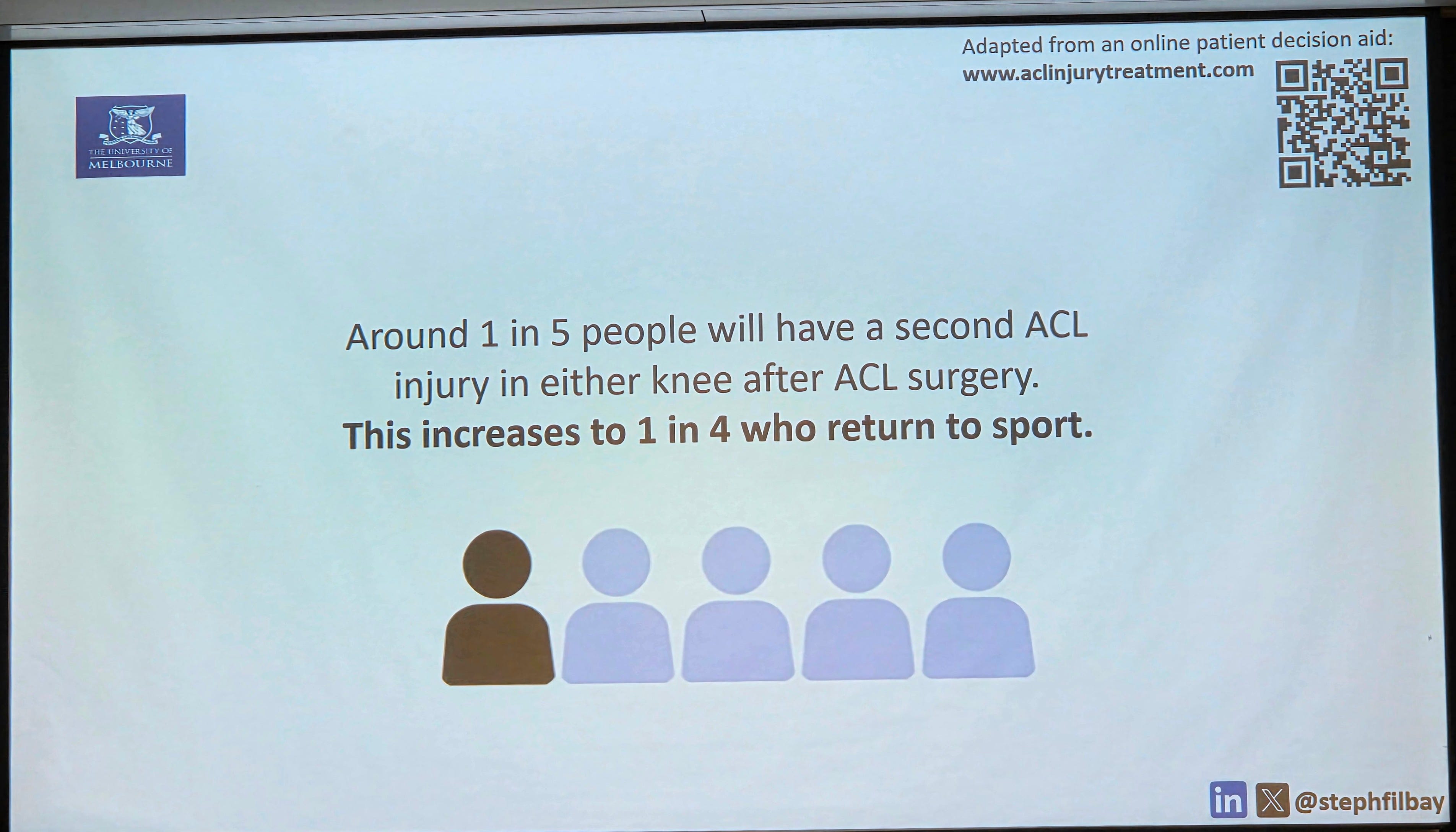
Steph Filbay again shone a light on rehab-first pathways (with optional delayed ACLR) delivering equivalent - sometimes better - outcomes for many people.
The emphasis was on informed choice: patients understanding the genuine options, timelines and trade-offs.
Monday move: Familiarise yourself with the ACL Treatment Decision Aid website and guide your next acute/sub-acute ACL consult there and start having some real (and sometimes hard) conversations about their next steps.
Steph also again reminded us all about the important EMBRACE trial that is currently underway here in Australia - here is the website for more information
3) Mental health flags aren’t side notes - they’re risk factors
Early data from The Gold Coast Knee Group (as presented by Matt Castro & Larisa Sattler) was a show-stopper.
Patients reporting anxiety/depression before ACLR were ~7.5× more likely to develop arthrofibrosis post-op.
That’s a clinical red flag we can actually do something about.
Larissa also shared findings of a Meta-Analysis and Systematic Review on LET (lateral extra-articular tenodesis): adding LET to ACLR may reduce graft failures ~3–5× versus ACLR alone.
Interesting trade-off: more pain at 6 months with LET, but by 12 months pain levels were similar to no-LET.
Read the paper here
Monday move:
Screen early for anxiety/depression; loop in GP/psych where appropriate; set expectations and pace rehab with both the knee and the nervous system in mind.
If LET is on the table, discuss the short-term pain bump vs lower failure risk, so patients aren’t blindsided.
Beyond the ACL Bubble…
Strength bias check: FAI management with Jo Kemp
Jo Kemp presented findings of the PhysioFIRST RCT - a physio-led program for FAI comparing (basically) strength+education to stretching+education over 4 months.
The result? Both groups improved quality of life similarly over the 4 month intervention period, but perceived pain improved ~2× more in the strength group.
This was my humbling reminder and bias check that strength isnt always the answer and it won't fix all ails; and serves as a reminder that education in itself is very powerful and an active plan that patients will do often beats the “perfect” program they won’t.
Monday move: When the person in front of you gravitates to stretching, don’t sneer. Pair it with education and maybe gradually nudge toward strength (but maybe for other reasons like sarcopenia and bone density).
In a nutshell, meet them where they are; build where they’ll go.
Read more about the preliminary work of the PhysioFirst RCT here and here
Intramuscular tendon (aponeurotic) injuries: not just “muscle strains”
Sam Pietsch (Head Physio for Melbourne City Football Club) highlighted how aponeurotic injuries (calf/quad/hamstring) behave differently to “muscle strains”, re-injure a lot (18–26%), and half of recurrences hit within 2 months of RTS.
Big tip: Early on, protect from elastic strain (first 2–3 weeks), use isometrics, then slowly but surely build in the isotonic work, progress running/plyos and ultimately heavy eccentrics.
Monday move: The biggest challenge we mere mortal clinic physios face is that we wont have the luxury of scanning every calf, quad and hamstring that walks in the door. So if the history of the patient is littered with re-injuries over the last few months and they are not progressing as you would expect, start manage it as intramuscular tendon until proven otherwise (plus probably biting the bullet and getting a MRI if everyone is on board) - with isometrics and heavy slow loading, before moving into plyos and high intensity eccentrics.
Read more about Sam's work on the Quads here
Fit for Purpose (Wand et al., 2022), championed by Merv Travers
I loved this framework and its simplicity across MSK care:
Understand it is safe to move
Feel it is safe to move
Experience moving safely
Consolidate safety
Read the paper here
Monday move: Map your session plan to these four lines. If a patient isn’t progressing, ask: Which step did we skip?
Circus hips and reproducible rehab
Charlotte Ganderton presented a brilliant preliminary findings that showed that a 4 stage HIP strengthening protocol (1× session face to face per week + 2× home exercise plan) for 12 weeks in circus performers with hip-related groin pain delivered improvements in hip IR/ER ROM, Y-balance, trunk strength, and single-leg rise.
Kinesiophobia improved only mildly - but again, skill exposure takes time. I loved this program as it required minimal equipment, 4 clear stages and progressions and could be done anywhere, anytime - my kind of practical.
Matt King on Foot Orthoses for Hip OA
People with hip OA often fall short of activity guidelines because… it hurts to move.
A 6-week trial found arch-support foot orthoses boosted walking by ~2,500 steps/day versus a flat insert; both groups improved PROMs.
Monday move: With low-activity, low-mojo hip OA patients, consider arch-support orthoses as a quick win to unlock walking while you build a strengthening plan.
The Talk That Stole the Show
Gillian (“Gill”) Hicks, survivor of the 2005 London bombings and now a bilateral below-knee amputee, delivered a keynote that had the whole room time-travelling between goosebumps and tears.
Her theme - “Agile in a fragile world” -landed hard for me as a clinician, a business owner, and a dad.
Resilience is vital, yes.
But it’s agility - the willingness to adapt, re-route, and meet reality as it is - that keeps people moving forward.
Her stories from rehab weren’t about superhuman grit; they were about teams who listened first, removed barriers, and solved problems with the person, not to the person.
Monday move: In every session, ask yourself: “Am I making this simpler to succeed, or harder?” Then pick one barrier you can remove today.
Four Monday-Ready Actions I’m Bringing Back to Clinic
Lead with fear, not force. Screen for kinesiophobia first in post-op ACL reviews; plan graded exposures before arguing over quads angles.
Normalise rehab-first in ACL decision chats. Offer a balanced script and resources for informed choice.
Flag mental health early. Anxiety/depression ≈ higher arthrofibrosis risk - address it as a knee-critical variable.
Bank small wins. From arch supports in hip OA to acceptable stretching in FAI - momentum beats perfection.
Final thoughts
As a physio 15 years into my career, I’m genuinely glad I finally experienced APA through this lens.
The 2025 APA Conference was equal parts humbling and energising; patient-centred research, practical takeaways I can use Monday, and a community that genuinely cares about making physio simpler, smarter, and kinder.
Huge thanks to the APA organisers, the speakers who challenged my biases, and the old mates and new friends I got to catch up with. I’ll be back.
Yours in (knee) health,
Mick Hughes